
Local search puts you in front of people already looking for you. Outreach puts your name in front of the immigration offices across Illinois that have never heard it. This is how the second piece works, what it costs, and what you do and don’t have to do.
Where things stand
Local search is working on the people who search for an evaluator. But the immigration work you do most of comes through attorneys, and most of it comes through one office. That office is a gift. It is also a single point of failure: one retirement, one move, one change in staff and the pipeline gets thin overnight.
The fix is more offices that know your name. Not a few hundred strangers at once, but a steady, personal introduction to the right people in each one.
Counts come from a first-pass search and will change. You review the list before anything is sent.
Local search so far
These are the numbers from your own weekly reports and the map scans we run every week. The first scans on September 17 and 23 found you nowhere. By September 28 you were showing up across the map for several of the searches that matter.
People who saw you on Google Maps
11→492
Requested directions to your office
4→21
Interacted with your profile
4→34
Visited your website from Maps
0→12
Google’s figures from your weekly reports. The earlier report covers August 19 to September 18 and the latest covers September 12 to October 7, so the windows are not identical, and your profile was only just live at the start. Read it as direction, not an exact multiple.
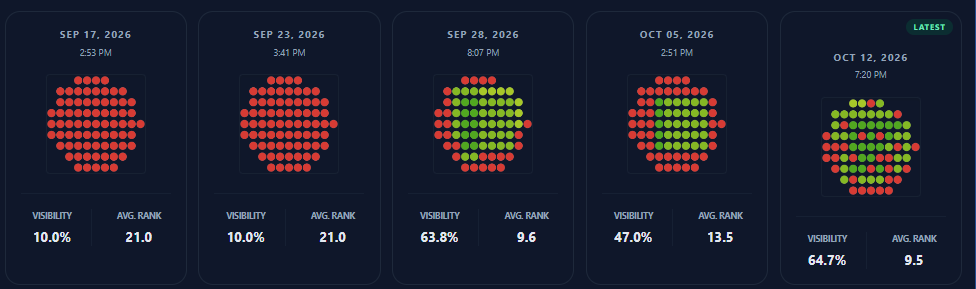
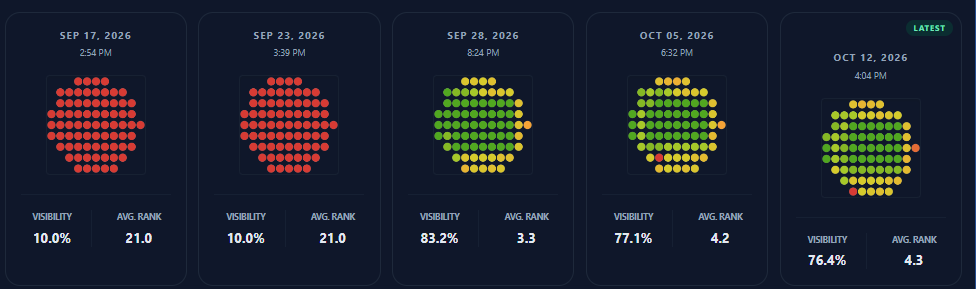
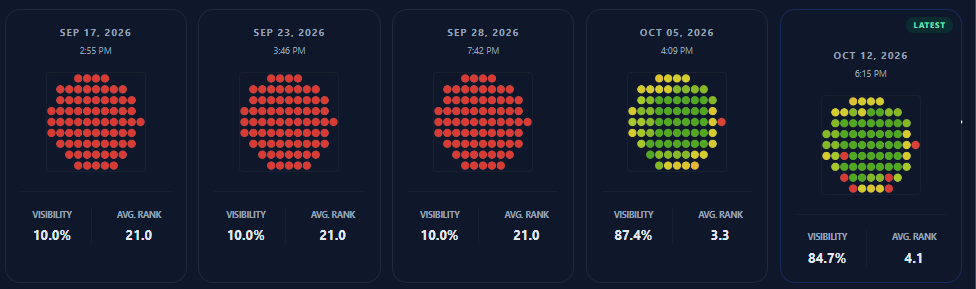
The honest read. The biggest jump happened in the first two weeks, as Google picked up the profile. Since then a few searches have moved a few points either way (adhd assessment for adults went from 87.4% to 84.7% between October 5 and 12), which is normal week to week. Immigration is the part still to build: “immigration evaluation” is at 64.7%, the narrower “immigration psychological evaluation” is at 42.1%, and asylum, VAWA and the Spanish-language immigration search are not showing yet. That is where the next months of local work go.
How it works
Most of this happens in the background. You see two things: a list and a set of messages to approve before anything is sent, and then interested replies that show up in your inbox.
The path from a name on a list to a case in your office
Illinois immigration firms, plus the attorneys and staff at each.
You see the list and every message before anything goes out.
A separate sending domain builds a reputation for about five weeks.
A short LinkedIn and email sequence over about two weeks per person.
Interested replies reach you the same day. You talk, send a sample report.
Who gets contacted
You told me the paralegals and staff are the ones who chase the evaluations. So they get their own message, not a copy of the attorney’s.
These are the people who schedule, follow up and need the report on time. They want to know what you need from them to start and how fast you turn it around.
Practical: turnaround, languages, what the office sends you to begin.
These are the people who choose which evaluators a firm uses. They want to know you are credentialed, reliable and easy to refer to.
Short: who you are, what you do, an offer to send a sample report.
One contact, day by day
Each person gets a LinkedIn profile visit, then a connection request, then three short emails over about two weeks. A reply or an unsubscribe ends the sequence for that person on the spot.
What each contact receives
The LinkedIn steps are optional and need your approval. See “What to know before you say yes.”
The first 13 weeks
A new sending domain has to earn trust before it can email strangers. That is why nothing goes out for about five weeks. The wait is the part that keeps your messages out of spam, and it runs alongside local search, which keeps working the whole time.
Weeks 1 to 13
Week 13 is the end of the 90-day term. We sit down with the real numbers and decide what stays.
What to expect
Attorneys choose evaluators through trust, and cold outreach is the start of that, not the finish. These are planning assumptions to show the shape of it. They are not promises, and the real figures will come from your own results.
From the list to a firm that sends you a case (illustrative)
Bar lengths show the order of magnitude, not exact scale. One new firm at your evaluation fee is a meaningful addition, which is why the program is built around steady conversations instead of volume.
What it takes to pay for itself. Growth costs $851 a month more than local search alone, so about $2,550 over the first 90 days. At your evaluation fee of $1,000 to $1,200, that is roughly two to three evaluations. One firm that starts sending you work covers it.
This is built to sit beside the relationships you already have, including the office that sends you most of your immigration work today. Nothing in it replaces them.
Your two options
Both start from the same foundation. Growth is the same local search with the outreach on top, priced at $1,500 a month instead of $2,000.
Month-to-month. Cancel anytime.
If local search ever stops, hosting on its own is $79 a month.
90-day term, then month-to-month.
Plus
After 90 days we review the numbers together and decide what stays.
What to know before you say yes
Timing. The first real emails go out around week six. Outreach does not produce cases in the first month, and I would not trust anyone who says it does.
LinkedIn carries a risk. The LinkedIn steps run through your own account, which means connecting your login. LinkedIn’s terms do not allow automation, and it can restrict an account it flags. I include those steps only with your written approval, and the program works on email alone if you would rather skip them.
Staying in bounds. Messages describe you as a Licensed Clinical Professional Counselor and cover Illinois only. They never include evaluee names or case details, and they never ask evaluees or their families for reviews. Sending happens from a separate domain set up for the program, so your own email address and website are never used.
Who does what
Builds and cleans the list. Sets up and warms the sending domain. Writes the messages and sends them for your approval. Runs the sequences, watches the results, and reports back.
Approve the list and the copy. Answer interested replies quickly. Send the sample report when a firm asks. Tell me when a firm sends a case so we know what is working. Decide on the LinkedIn steps.
Terms, plainly
Local search is month-to-month. Growth is a 90-day term, then month-to-month. After the first 90 days you can stop whenever you like.
The list and every message go through you before anything is sent. Nothing goes out in your name that you have not seen.
The website, the Google Business Profile and your directory profiles stay registered to you.
You get the real numbers, including the weeks when nothing moves. At 90 days we decide together whether it earns its place.
If Growth looks right, tell me and I will set up your approval session for the list and the first messages. If you would rather start with local search alone, that is a fine answer too.
Henry Harrigan
Harrigan Creative · Urbana, Ohio